Wondering what to pack for our women-only tours to The Galapagos? Going on an expedition to the Galapagos archipelago and wondering what to bring?
In this article you’ll find an intro to the weather in the Galapagos and a handy list of suggestions for things women should pack for this trip.
See our Amazon Galapagos packing list with all the product recommendations mentioned here.
The weather in The Galapagos Islands
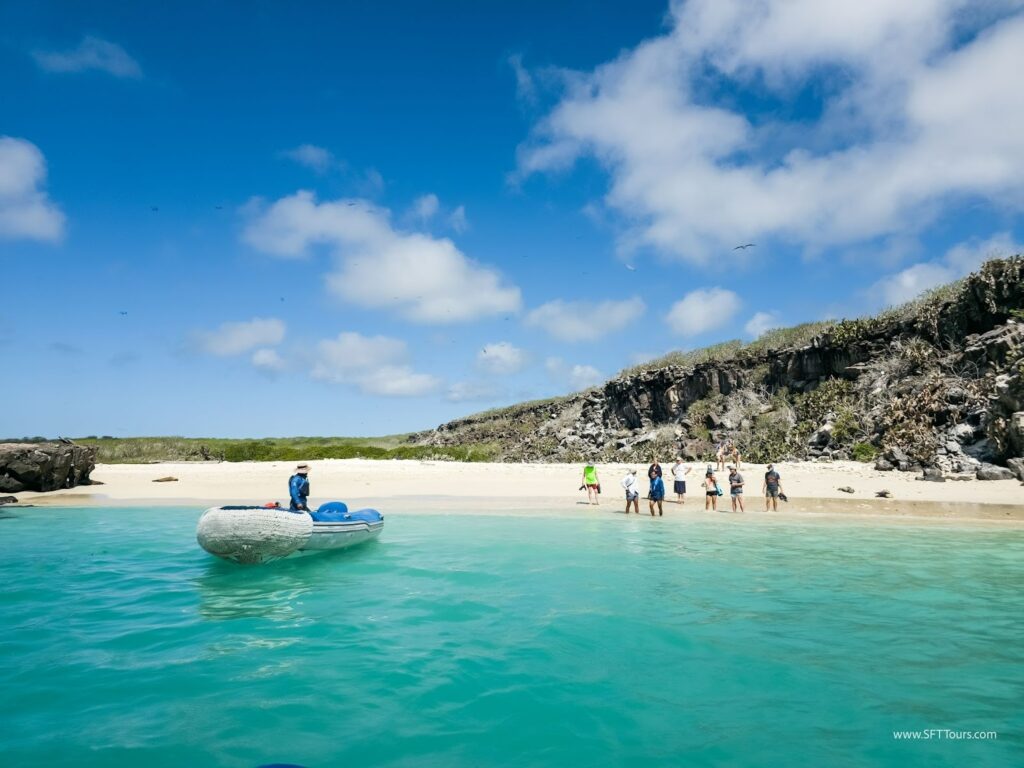
The Galapagos Islands are an archipelago of islands off the coast of Ecuador. They are located right on the Equator, but with clearly defined seasons as a result of the winds and sea currents in the area, which bring cooler temperatures than other low-lying Equatorial islands around the world.
Besides rainfall and temperatures, when looking at the weather in the Galapagos, you should strongly consider the wind, the water temperature and the sea condition and visibility, all of which are important decision factors when thinking about when to visit.
In the table below, we have summarised the month by month weather conditions:
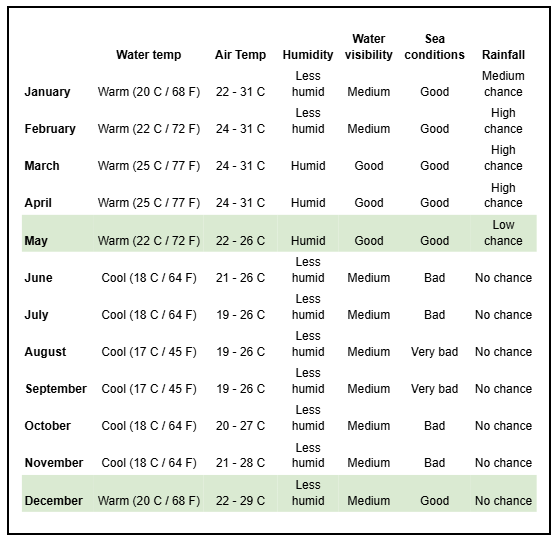
May and December are the best months in The Galapagos because they combine good visibility and sea conditions with warmer water and surface temperature, albeit humidity is high.
The worst months to visit are the summer months, when visibility and sea conditions are the worst and the water is cold, even with a wet suit. This isn’t ideal when most plans include long periods of time snorkeling.
However, during these months, the chance of rainfall and humidity are low, so these may be good months to visit if you plan to spend more time on land, and if you’re someone who doen’t tolerate heat very well.
When thinking about how the weather affects what you wear in the Galapagos, you also need to consider hours of sunshine and lack of shade.
With the exception of Santa Cruz’s interior, The Galapagos Islands have little to no trees, and hardly any natural water. This means that when going on hikes and walks to meet land-based animals, you’ll be exposed to the beating sun and depending on the month, to mosquitos.
Some islands suffer from a higher mosquito population than the ones we visit on our itinerary in May. Typically, they come out in force in the rainy season and in urban areas.
How to dress in The Galapagos
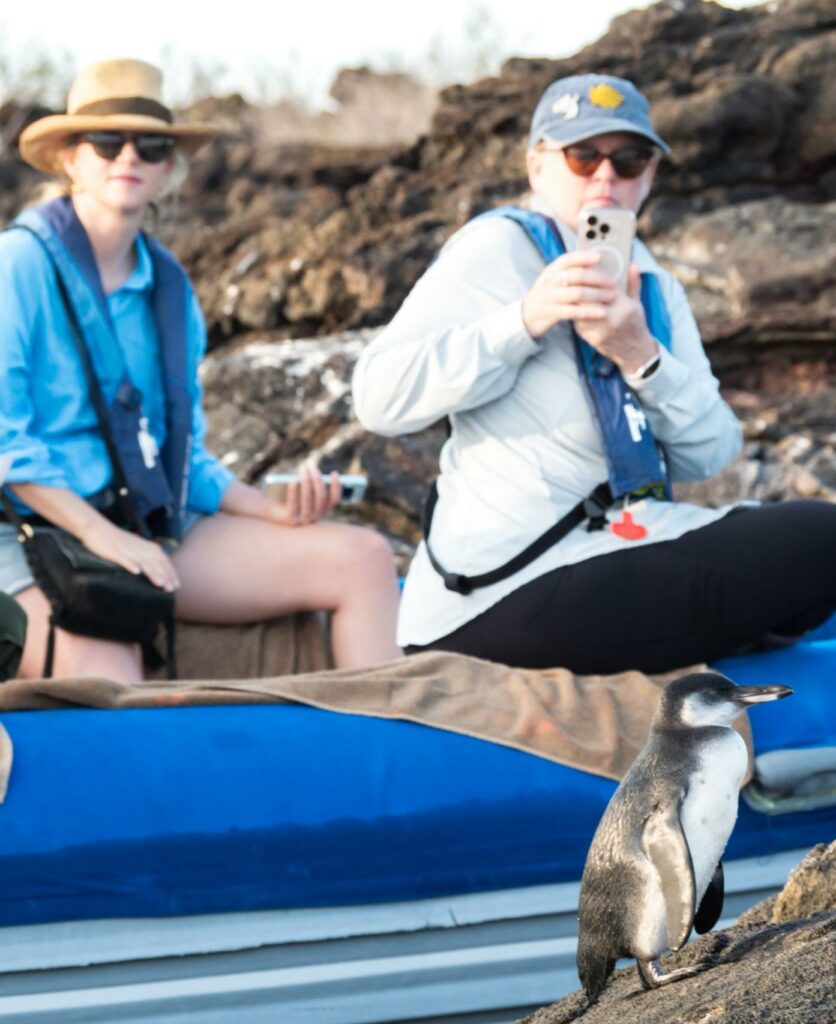
Knowing that temperatures in the Galapagos are generally warm, humidity can be quite high, and that the sun is strong because of its Equatorial location, wearing the appropriate clothes is a must to avoid heat stroke and sunburn.
In general, your days in the Galapagos will include any of the below activities, and therefore, your packing should bear that in mind:
- Swimming
- Snorkeling
- Hiking / walking on board walks, beaches, sandy, rocky or volcanic paths
- Kayaking
- Chilling on deck, your balcony or in the jacuzzi
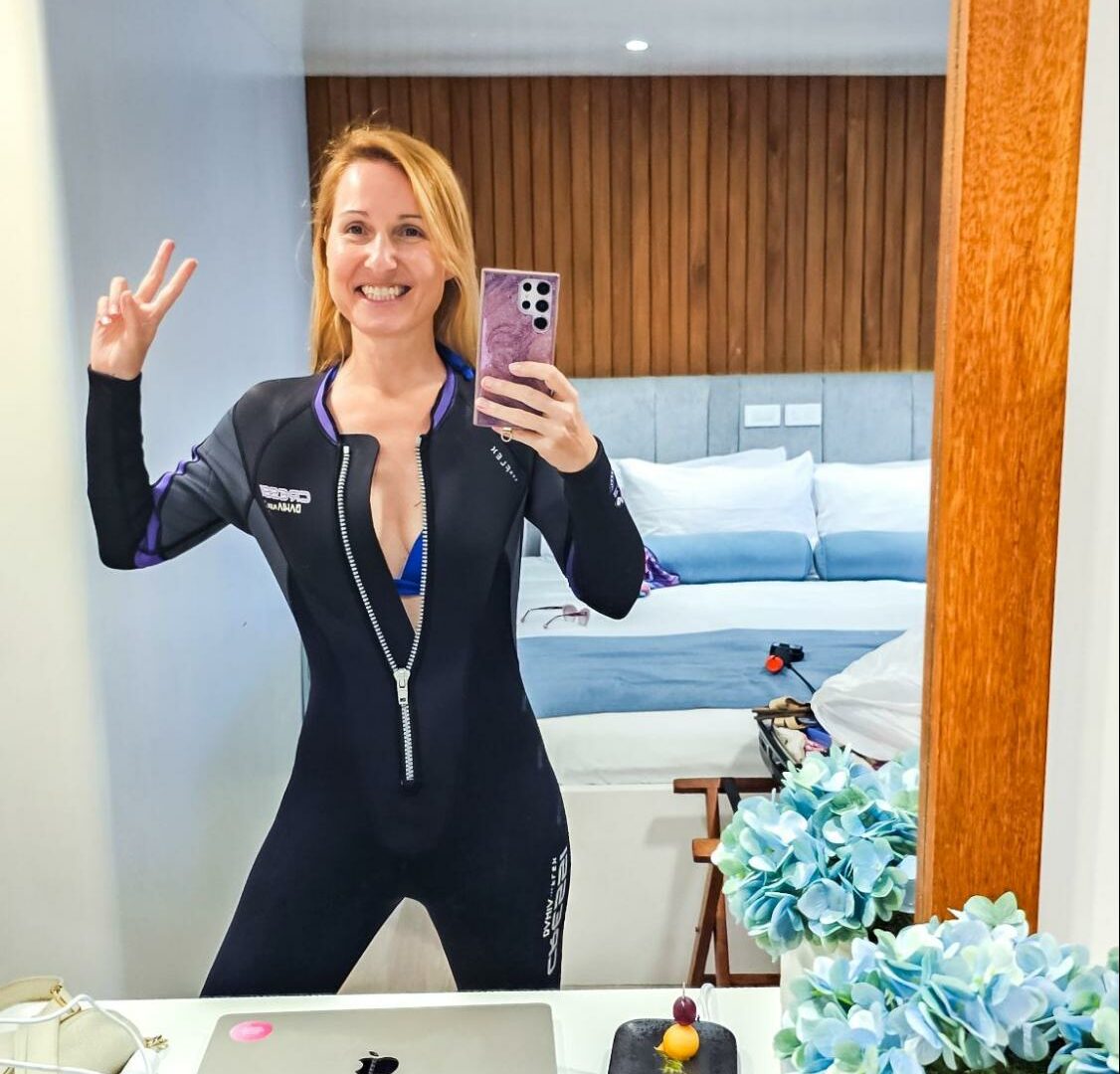
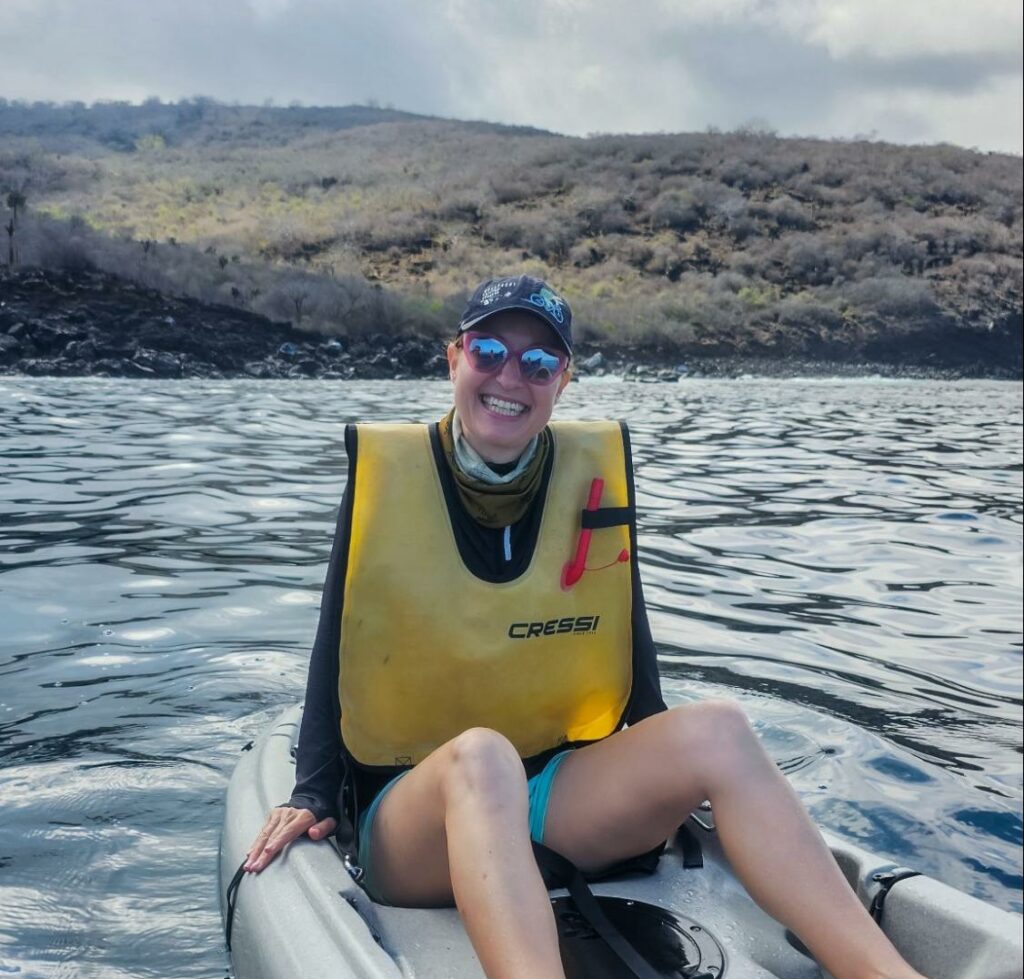
We are staying on a luxury boat, so you will be provided with technical gear for all activities, that is, snorkel, mask and fins as well as a long wet suit for snorkeling and kayaks, and life vests for kayaking. If you don’t know how to swim, you can wear a life vest for snorkeling, and a floatation ring is also available.
Breathable quick dry materials and proper cover
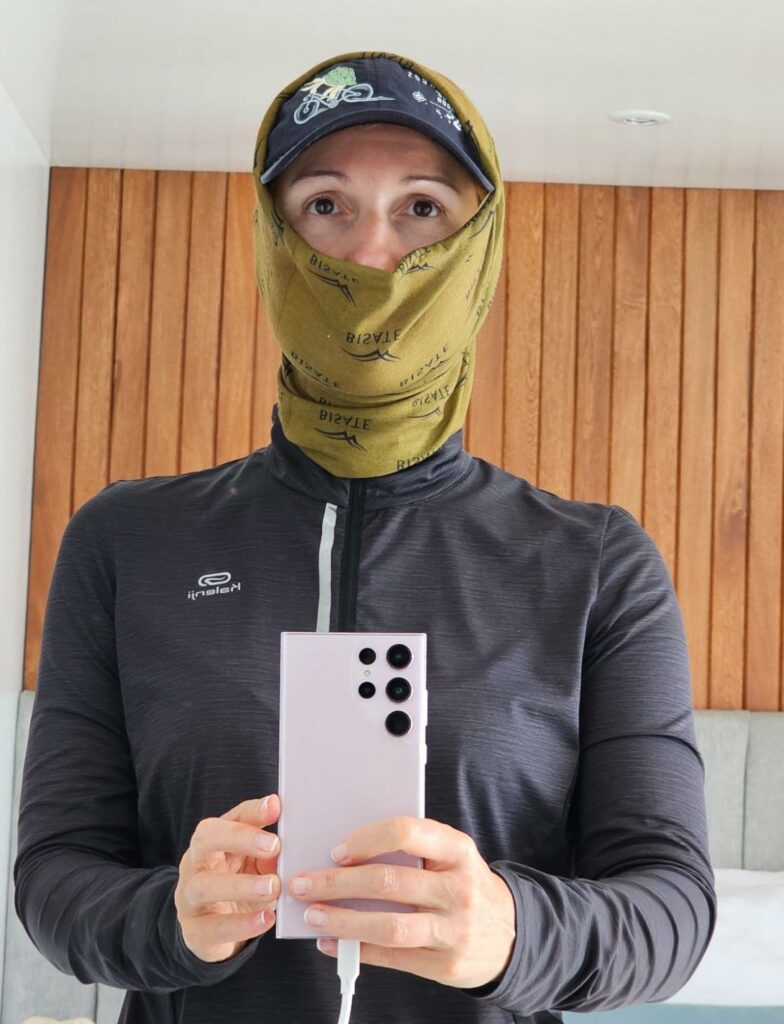
Very few islands in The Galapagos have any shade and trees are scarce.
Santa Cruz’s island center is higher, tropical, wet and forestry, but most of the other islands have barely any trees or shade. Your zodiac excursions will also be exposed, as these are small dinghy boats.
Most of the land excursions happen either early in the morning or late in the evening, when it is less hot, and last about 1-2 hours each. At that time of day, sun rays are oblique and come from the side rather than from above your head, and this means that a cap will only cover your head but not your neck, cheeks, ears, etc.
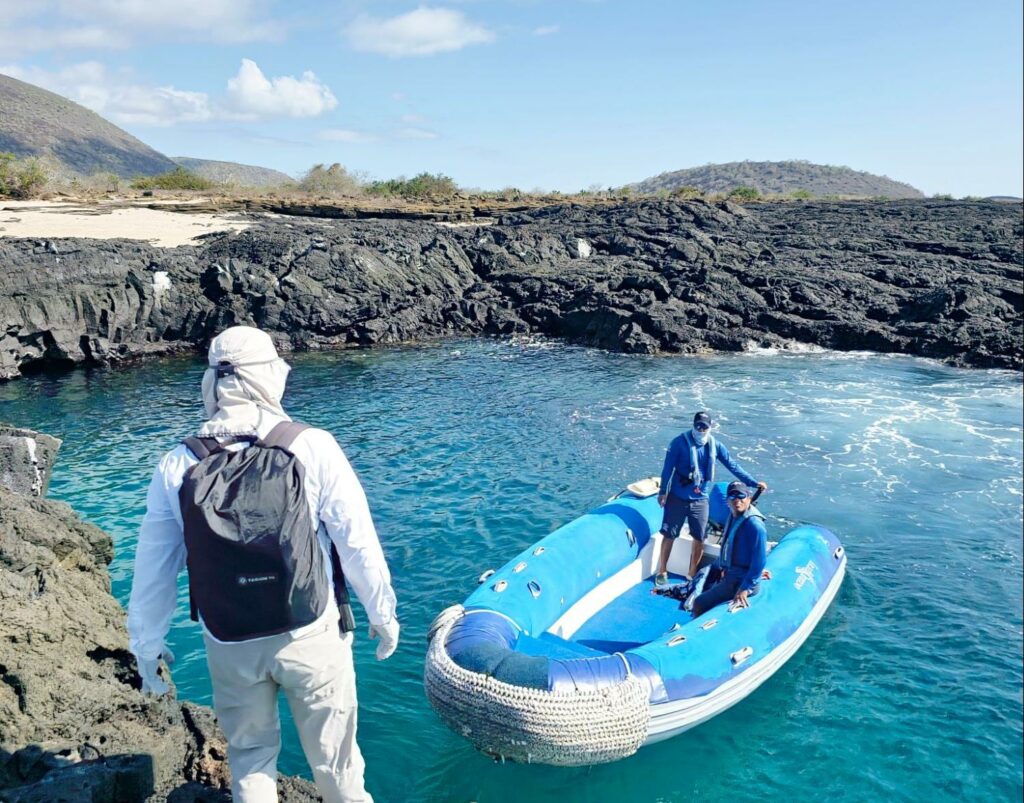
Local guides and staff on boats all wear long sleeves with collars, gloves, caps with neck flaps and long pants so they are fully covered from the sun. When you spend so much time under the sun every day, it pays to fully cover to avoid sun damage.
It may be tempting to wear as little clothing as possible in the warmer months, but it is wise to adopt their approach to clothing to avoid sunburn, strange sun marks and mosquitoes.
Long sleeves, collared tops, caps with neck flaps or wide brim hats, buffs, and even long trousers are all a good idea. In the summer months, you may be sweating a lot so breathable technical clothing made for the outdoors and materials that are quick dry will help.
Casual active / technical wear
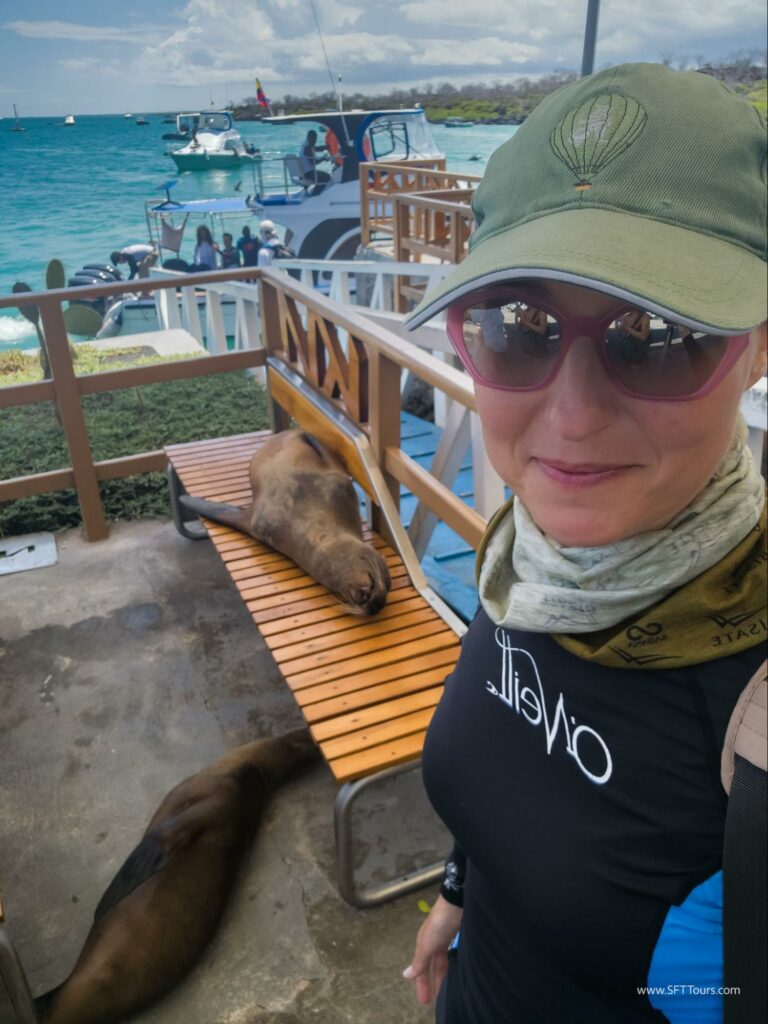
The Galapagos is an eminently casual destination where everyone wears comfortable summer active wear such as SPF rash vests, quick dry sports shorts, all-terrain sandals or reef shoes and sports hats / caps.
You will likely sweat, spend quite a lot of time wet, and often have little time to get changed between activities.
The landscapes can be quite dry and dusty in the dry season or muddy and wet in the rainy season. Waking paths can be sandy, beachy, volcanic, rocky and sometimes slippery if wet, like when walking on board walks.
Some landings are dry, meaning you walk off the zodiac and onto a dry surface, but many are wet and you will step off the boat on the beach or a reef and get your feet wet.
On the islands, in the evenings, you could wear a nicer outfit, a sun dress, a pair of cute trousers or a long skirt, but bear in mind that mosquitoes are more active at night.
Pack light and wash on the go
Domestic flights in Ecuador to Coca for the Amazon or to the Galapagos are on small propeller planes with limited space so there is a maximum weight limit allowance of 20kg for checked luggage.
Inter-island flights in the Galapagos only allow for 10kg of checked luggage, larger suitcases will have to be taken by boat which delays their arrival.
Pro tip: our trip is on a catamaran so we will be moving between islands on our own boat, hence inter-island flights aren’t necessary. If you decide to stay longer in The Galapagos you can consider taking a ferry to get around the luggage allowance limitation.
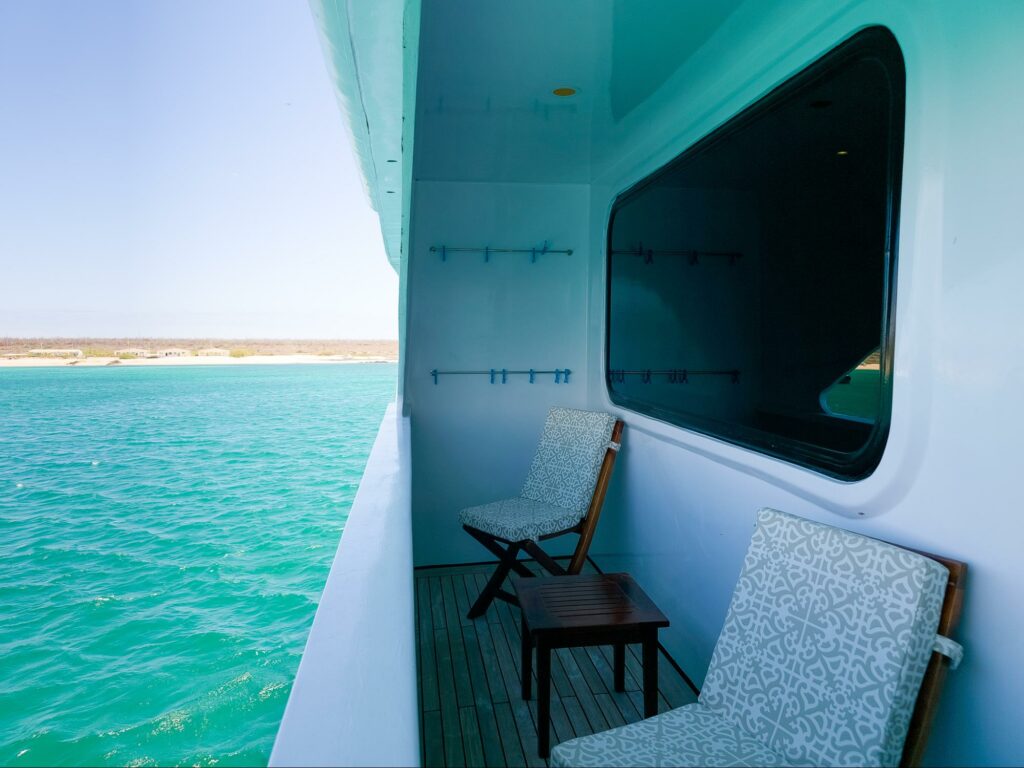
If you bring quick dry clothing, you can easily wash it in the sink and hang it out to dry on the boat’s balcony which has a small clothes hanger for that purpose. Or you can send your clothes for laundry.
What to pack for a trip to The Galapagos
When thinking about what to pack for The Galapagos you need to bear in mind all of the above: breathable, quick dry active wear that provides coverage is best.
Long sleeved tops
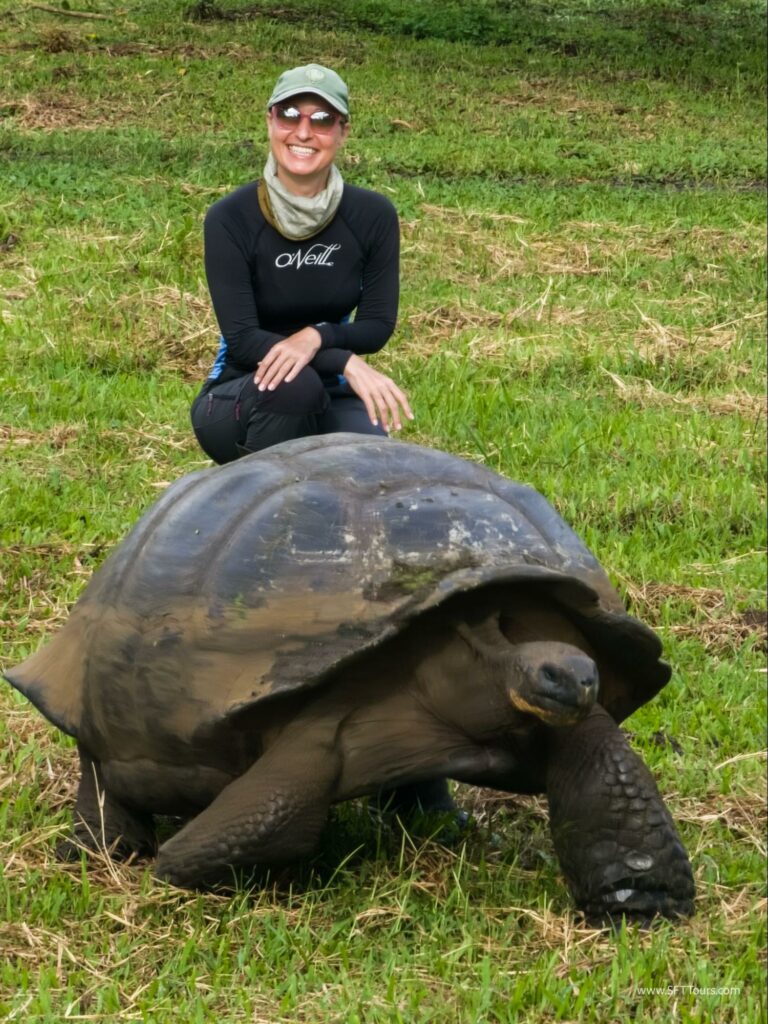
Quick dry, moisture-wicking, light, long-sleeved tops that protect from the sun and the bugs are best for daily excursions.
- I wore a lot of high collar, long-sleeved light rash vests with SPF protection. Some of them even had a hoodie that I could pull over my cap when the sun was lower and the rays were coming sideways to cover my face from the sun. I have one like this highly rated one with a zip and one without a zip like this.
- I also had a couple of collared safari style long-sleeved shirts like the ones the guides wear that I combined with a buff that I could pull over my face as well if the sun was strong.
It is also worth it to pack a sweater or light jacket for the evening when the temperature may drop and it could be windy, in case you want to lay down on deck to watch the stars. Airplanes are also cold spaces so this can be the layer you wear onboard.
Shorts and long light trousers
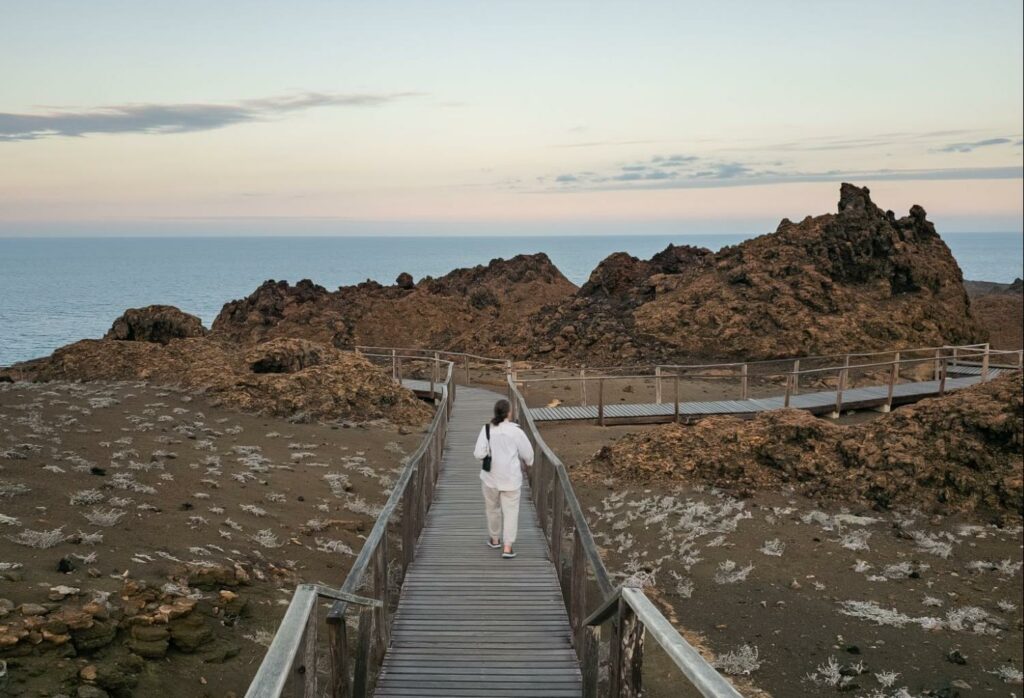
In keeping with the sun / mosquito protection, I preferred to wear light long trousers such as hiking pants for my island walks, but shorts will also work if you get hot and are happy to wear repellent and / or sunscreen, or for sunrise excursions when the sun is not strong yet.
Shorts will also be good while onboard, where mosquitoes aren’t an issue and you may be chilling on the top deck, reading a book or having meals. Hiking trousers that are convertible into shorts are also a good idea.
If you don’t have hiking trousers, any lightweight, quick dry and moisture wicking pair of trousers such as yoga pants or leggings will do. Even just a pair of linen trousers will make your land exploration comfortable, it will just be harder to keep from getting extra creased during travel.
Sun dresses
This is not so much a must-have item, since you can wear any clothing at dinner, but I found I was most comfortable wearing a sundress or shirt dress at dinner after having had a shower, or for some sunset excursions that involved board walks and no mosquitoes.
The dress code in The Galapagos is definitively casual, as mentioned above, but a dress may be a comfy outfit for group meals and evening chats. This can also be useful on land when it is hotter.
Proper shoes
You should wear appropriate footwear for the excursions. If you are coming from the Amazon or other parts of Ecuador where you will be doing some hiking, the same hiking shoes or boots will be useful.
If you weren’t already packing hiking shoes / boots, a pair of sneakers will also do, as long as they have good traction.
A pair of water / reef shoes will be useful for wet landings and for walking on the hot beach sand, but make sure they have a thicker sole than the typical neoprene shoes that have no grip or sole protection. Something like this.
Alternatively, a pair of sports sandals like this from Teva are also a good option for both walks and wet landings.
Lastly, while onboard, you will be leaving the shoes you will wear on land outside the yacht to keep it clean and so the crew can wash them and you don’t carry vegetation from one island to the next. If you have deck shoes and space, you could wear them in the yacht. I was either barefoot or wearing a pair of flip flops like this onboard.
In all cases, I would not bring the newest pair of shoes you have because you will sometimes walk on sharp volcanic rocks that may slash the soles.
Swimming gear
You are visiting an archipelago of islands, so quite a bit of time will be spent in the water exploring the marine life.
Every day, there will be snorkeling excursions, kayaking or zodiac trips on offer, you will also have the chance to swim and enjoy the beaches. While kayaking and zodiac trips can be done in regular clothes, it’s a good idea to wear your swim suit underneath, just in case you spot a pod of dolphins and have the opportunity to jump in.
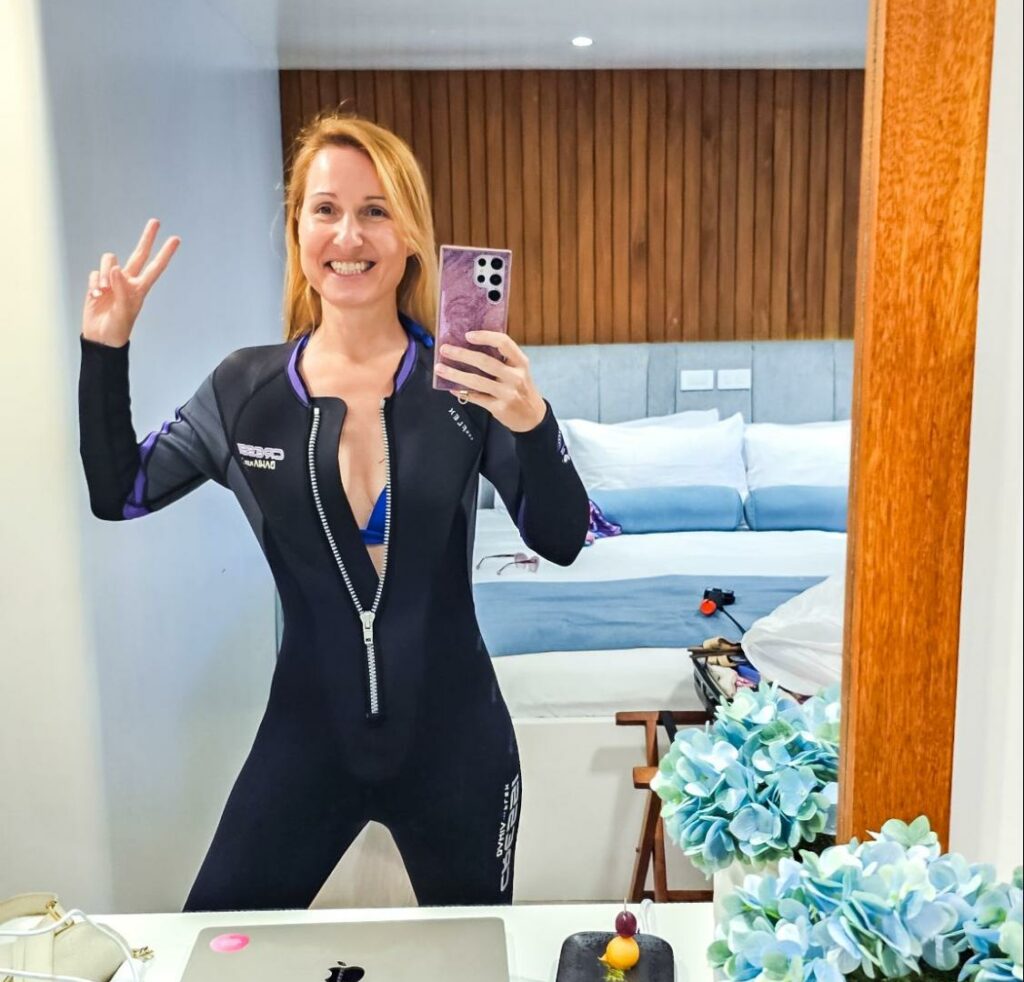
Our luxury boat will have long wet suits available for the snorkeling excursions as even in the warmer months, the water isn’t that hot, especially after an hour of swimming. Under the wet suit, you can wear an extra warm neoprene layer, especially in the colder months, or a rash vest.
Bring at least a couple of swimming suits / bikinis because on most days, you will get in the water twice.
A waterproof day pack
If you’re bringing a proper camera, it pays to have your own waterproof bag to store it in for zodiac excursions and kayaking trips.
This will also be useful in case of rain, since it is always a possibility, even in the dry season, or if you are visiting Santa Cruz’s island center which is always wet.
Here are two great options:
- Osprey’s small waterproof day pack that packs light and small into its own case and you can use as day pack even if it does not rain,
- This hardcore drypack that is also useful for any water sports you do in the Galapagos (kayaking, sailing, etc.) packs light for travel and floats. It can act as your day pack too.
Other items you should pack for your trip to The Galapagos
 | Ziplock bags: Your clothes may get dirty and wet during the trip and they may not have time to dry. Your electronics could also get wet with sudden downpours or water splash. Bring ziplock bags of various sizes such as these ones to organize your dirty laundry and seal your electronics. Dry bags are also a good option. |
| Neoprene hat: I always pack a neoprene hoodie when going snorkeling or diving so I can keep my head warmer and my hair out of the mask’s locking mechanisms. | |
 | A phone lanyard: A phone lanyard is super useful to travel with anywhere. You will have your hands free and your phone always handy for photos. This is especially useful when on a zodiac so it does not fall in the water. I have this one. |
 | Universal plug adaptor: Plugs in Ecuador are type A and B, two-pronged flat ones like in the US. The best way to ensure you will be able to use any plug is by packing a universal adaptor. I like the ones which come with USB ports so that I can charge phones, cameras and everything else with just one adaptor. I love this one because it has USB ports for all the electronics I now carry. |
 | Power bank: A portable charger can be an essential on long days exploring.This Anker Portable Charger has a 20000mAh capacity, and fast-charging USB-C ports, you can power up your devices in a flash, while the LED display keeps you in the know about your battery level. It’s the perfect companion for a day out on safari when you will be using your phone a lot to take photos and videos and will use up that battery a lot. |
 | Sunglasses: Sunglasses are essential for protecting the eyes from harmful UV rays and glare. I have been wearing Oakley for more than 30 years and currently use these ones. |
 | Water purification bottle: Single use plastic bottles are terrible for the environment and banned in The Galapagos so I recommend you bring your own to create drinkable water from tap water. The catamaran has water coolers where you can refill your bottle but if you are staying longer on the islands, you will want to have your own potable water making device. I brought my Grayl water purifier bottle to Ecuador and it was a game changer. |
 | Water bottle: I like to bring a water bottle in addition to the water purifier bottle because the latter is heavy and I don’t need to carry the purifier part of the bottle if I have access to drinking water. So I filter water with my Grayl and then fill my portable water bottle to take with me and leave the Grayl one at the hotel. |
 | Repellent: Repellent is a must in The Galapagos islands, especially in Santa Cruz or San Cristobal. I have been using the Repel brand for decades. You may also douse your clothes, including shoes and socks, with permethrin to make them repellent. |
 | Sun hat: Caps with a neck flap and chin strap are worn by guides and deck staff at all the boats in the Galapagos to keep the sun rays away and make sure they have their hands free when going faster on the zodiac. One like this, with a neck flap that can be clipped on or off, is a good option so you can use it as a regular hat or with the extra neck protection.If you prefer to wear a regular cap or hat, the extra chin straps are useful. |
 | Portable fan: In the Amazon, where temperatures and humidity can be very high, a portable neck fan will feel glorious. We have many guests use this particular one on our summer trips in Europe and I wish I had one every time. |
 | A neck gaiter: Can double up as a face and neck cover and keep any dust out of your mouth and nose. It can also be used as a head cover. I have one from the brand Buff (Barcelona based) like this one. |
 | Waterproof phone case: For kayaking and zodiac excursions, place your mobile phone inside a waterproof phone case to keep it dry. This one is a best seller and comes with a lanyard. It can also store other small items. |
 | A rain jacket or poncho: Rain is possible year round, especially in the highlands of Isabela and Santa Cruz. Pack a light packable raincoat or a poncho and have it with you when out all day so you can stay dry. It can also be useful to wear when on deck at night when it get chilly. |
 | Wet wipes: Useful when it is humid and muggy and you sweat a lot, to freshen up. Make sure they are biodegradable like these Combat ones, waste management in The Galapagos is difficult (you will hear about it during the tour). |
 | Sunscreen: The sun burns at higher altitude even on cloudy days so sunscreen is a must. I like and use the Japanese brand Biore SPF 50++++ for my face because you can wear it under makeup and it is non-sticky and silky smooth. For the body, I highly recommend Aussie brand Sun Bum which is specifically designed for Australia’s super strong sun, is vegan, reef-safe and smells heavenly. They have a travel pack with sizes below 100ml that comes with a pretty pouch and includes sunscreen, lip balm (very important) and aftersun. |
 | Washing sheets: To hand wash your clothes on the go or rinse your swimming gear, bring space saving hand wash-friendly detergent sheets like these eco-friendly ones. |
 | Lip balm: Lip balm is essential for the windy boat rides and the dry sunny weather. This Nivea one comes in a pack of 4 and has SPF, so your lips will never be dry again! |
 | Sleep mask: If you’re a light sleeper, and can’t handle any light coming in guarantee your sanity and a good night’s sleep by bringing your own mask like this one to block the light. |
 | Pajamas: On our tours, we pair you up with a fellow solo female traveler that we think you’ll get along with – so don’t forget to pack your pajamas. Here’s a comfy choice from Amazon. |
 | Ear plugs: If you are a light sleeper, a pair of ear plugs can help you sleep better, especially when we sail overnight and you may hear the sound of the anchor or the motor. Check these out on Amazon. |
 | Travel pillow: If you are flying overnight, you will need a proper neck pillow to sleep and arrive rested. Me and Meg both use the Turtle neck. |
 | First aid kit and medication: Available medications, brands and products in Ecuador are not the same as back home, and many basic items may require a prescription, so it’s always best to bring everything you are used to and of course, all prescription medication or vitamins you take. You should also think about packing a basic first aid kit with items such as painkillers, plasters and antiseptic ointment, motion sickness tablets, antihistamines, electrolyte powder in case of diarrhea (or hangovers form all the whisky), plus any other tummy ache related tablets or medicines your doctor may suggest (antacid, diarrhea tablets, etc.). Quito and Otavalo are located at high altitude, so you may want to consider discussing your needs and options with your doctor. Don’t forget blister bandages in case you get blisters in your hiking shoes boots. See our First Aid Kit list here. If traveling in the spring, consider bringing anti allergy medication. Important: Make sure that any medication you take is allowed in Ecuador. |
 | A foldable toiletry bag: I always travel with a foldable toiletry bag which I can hang anywhere. They also help you keep everything easy to find and tidy when the boat moves. This one is very cute and functional! |
What not to pack for a trip to Ecuador
There are a few things that you should reconsider bringing along with you to Ecuador because you won’t need them and they would take up valuable space, or because they are not recommended.
- High heeled shoes: You will have nowhere to wear them in The Galapagos.
- Hair dryers: All cabins have them and you will be spending your days with your hair tied in a pony tail which is better for swimming, hiking, etc
- Any fresh foods: Other than packaged snacks, you can’t bring any fresh food into the Galapagos as they are remote and the islands take biohazards very seriously.
- Technical gear such as wet suit, mask, snorkel and fins, unless you have your own and prefer to use that.